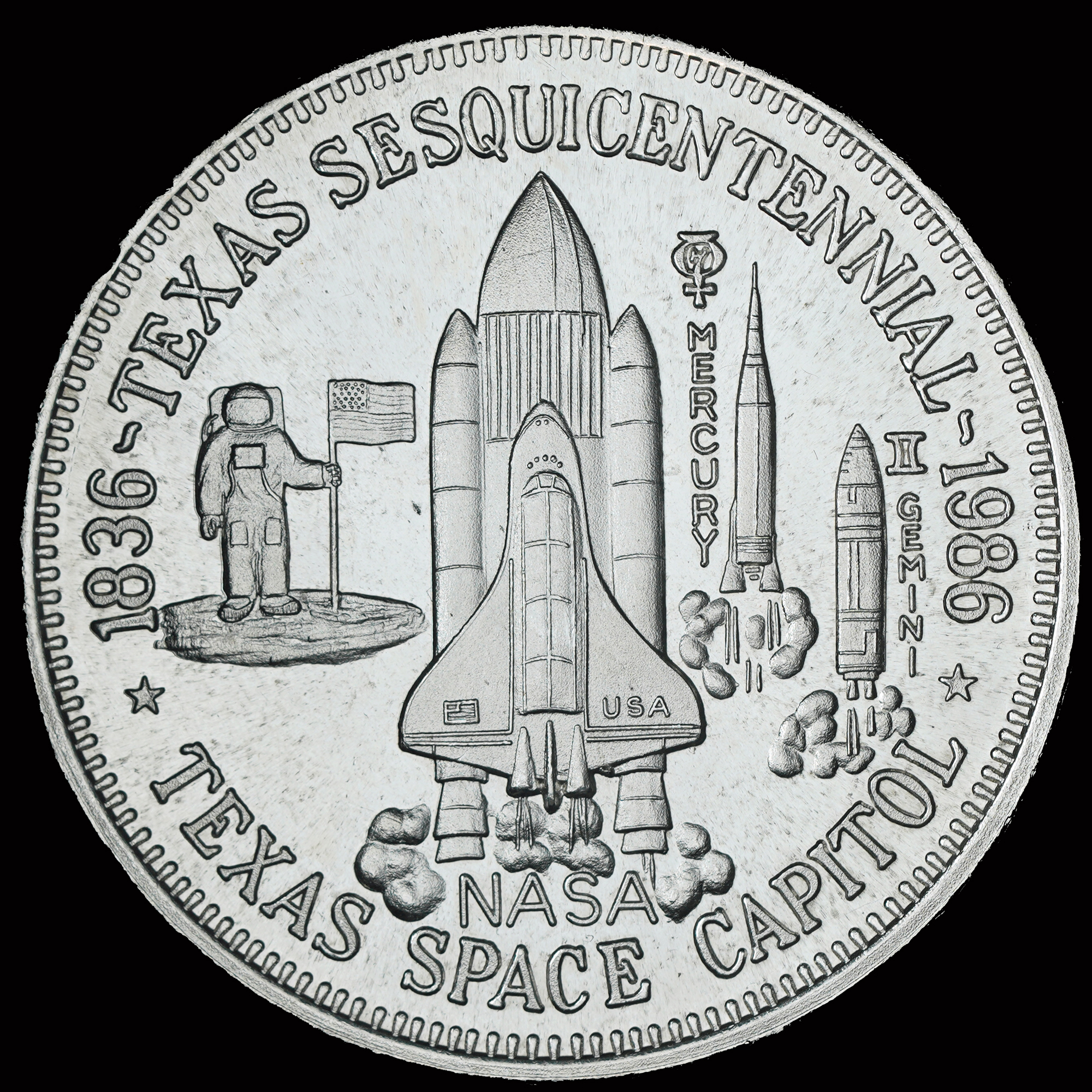

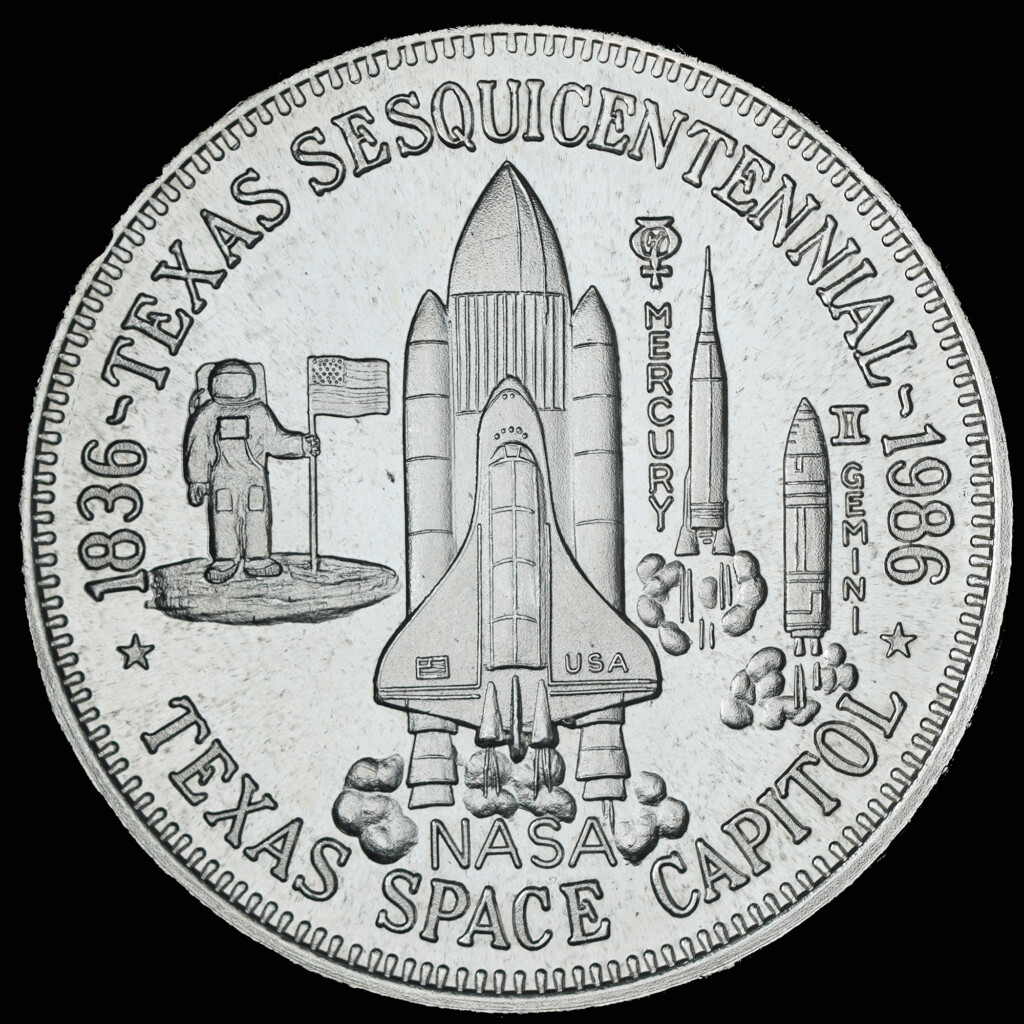
A space shuttle on its launch plume stands at the center, with an astronaut holding a flag on the Moon at left and the Mercury and Gemini rockets at right, labeled "MERCURY" and "GEMINI." "1836 - TEXAS SESQUICENTENNIAL - 1986" arches across the top and "TEXAS SPACE CAPITOL" along the bottom, with "NASA" under the shuttle and "USA" on its wing.
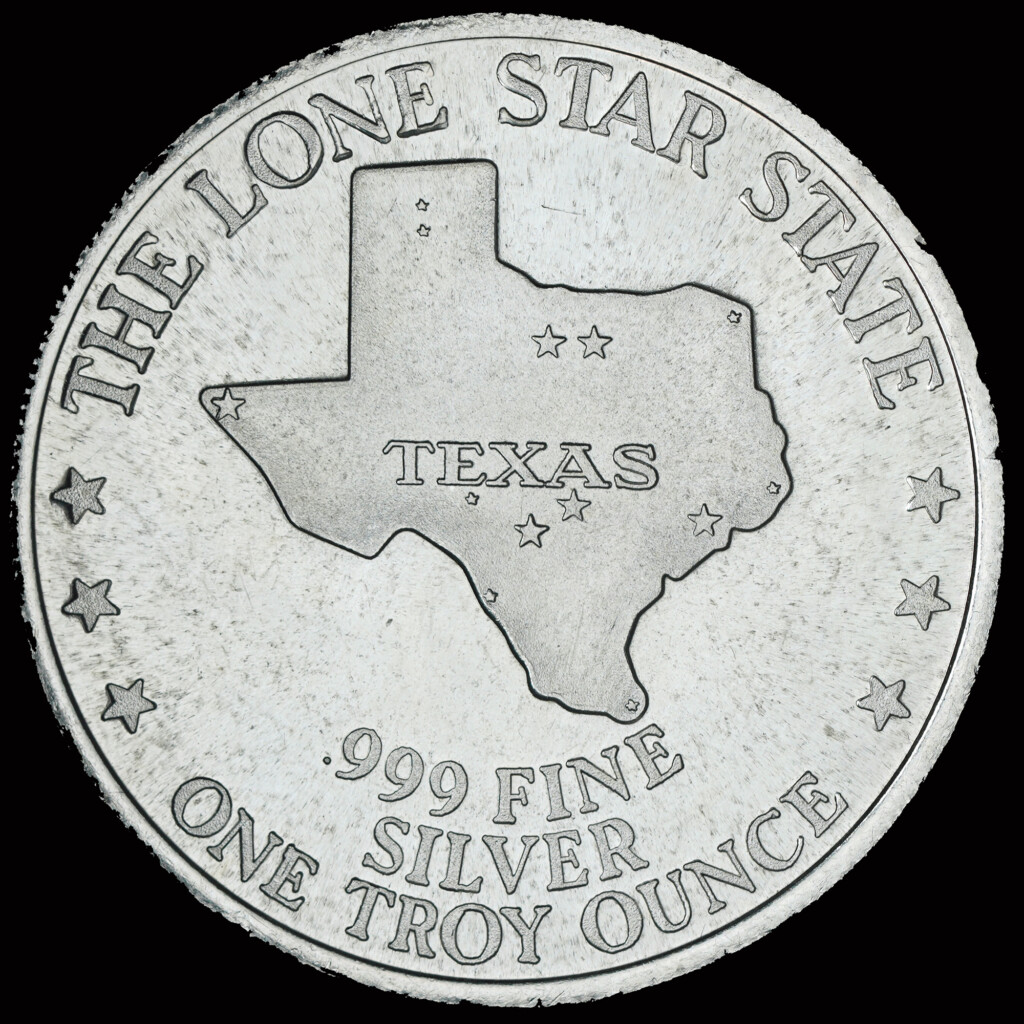
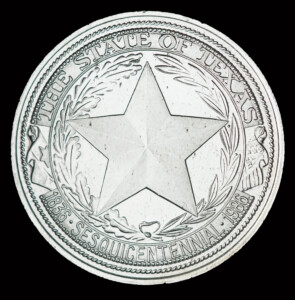
"THE LONE STAR STATE" arches over an outline of Texas bearing the word "TEXAS" and scattered stars. ".999 FINE SILVER" and "ONE TROY OUNCE" are struck below.
Issuer and distributor attributed to Colonial Coins, Inc. per a period Coin World advertisement listing the "Space" design in 1 oz silver. No mint mark or maker's name is struck; manufacturer unknown.
The 1986 NASA Space Capitol Lone Star State silver round has a steady sales history from 2011 through 2023, with no recorded sales in the past three years.
| Date | Price | Notes |
|---|---|---|
| Aug 11, 2023 | 99.99 | Most RecentHighest Ever |
| May 29, 2023 | 36.00 | UnverifiedNASA in title but photo shows plain Texas-map design; included per Tex |
| Nov 23, 2022 | 48.00 | |
| Mar 21, 2022 | 24.95 | |
| Aug 11, 2020 | 45.00 | |
| Apr 3, 2020 | 21.50 | |
| Apr 2, 2020 | 39.95 | |
| Mar 16, 2020 | 22.00 | |
| Jan 20, 2020 | 15.50 | |
| Dec 8, 2019 | 22.37 | |
| Sep 21, 2018 | 37.95 | |
| Apr 21, 2017 | 26.00 | |
| Apr 16, 2016 | 32.00 | |
| Mar 30, 2016 | 39.00 | |
| Dec 19, 2015 | 42.00 | UnverifiedNASA in title but photo shows plain Texas-map design; included per Tex |
| Feb 3, 2013 | 44.95 | |
| Jan 12, 2013 | 34.75 | |
| Apr 6, 2011 | 48.00 |
Scroll for full 18-sale history ↓
1986 NASA – Lone Star State Silver Round Overview
The 1986 NASA – Lone Star State Silver Round is the space design of The Lone Star State Collection, a six-design 1986 series sold through Colonial Coins, Inc. of Houston for the 150th anniversary of Texas independence. Most of the series looks back to the Revolution. This one looks up. It sets a space shuttle on its launch plume, an astronaut holding a flag, and the Mercury and Gemini rockets under the words “TEXAS SPACE CAPITOL,” and it ties the sesquicentennial to Texas as it stood in 1986.
The claim has a basis. According to the Handbook of Texas, NASA Administrator James E. Webb announced on September 19, 1961, that the Manned Spacecraft Center would be built in southeastern Harris County, about 25 miles from downtown Houston, at the edge of Clear Lake, on a 1,000-acre tract Rice University was to transfer. Critics questioned the roles of Vice President Lyndon B. Johnson and Rep. Albert Thomas in the choice, and NASA denied any political influence. The center formally opened in September 1963. By October 1966 it had more than 5,000 workers on 1,620 acres. On August 17, 1973, it was renamed the Lyndon B. Johnson Space Center. Houston’s only official nickname, according to a NASA Johnson Space Center presentation, is Space City. The phrase on the round, “TEXAS SPACE CAPITOL,” is its own wording.
The two small rockets on the round predate the move. Project Mercury was set up in 1958 under the Space Task Group at Langley, and John Glenn’s three-orbit flight in February 1962 was planned and flown from there. Houston took over Mission Control duties with Gemini 4. The labels “MERCURY” and “GEMINI” are struck beside their rockets, each with its own symbol.
The astronaut is the Apollo story. Apollo 11 launched July 16, 1969, and on July 20 Neil Armstrong became the first person to walk on the Moon, with Edwin Aldrin second. In the NASA presentation’s words, the landing included “Houston” being the first word transmitted from another world. The round shows the flag-bearing astronaut standing on the Moon’s surface. That first word, “Houston,” is also the name of the general on the [Sam Houston design]([add URL]), who won Texas independence in 1836.
The shuttle at the center was the new fleet. President Nixon approved the shuttle program on January 5, 1972, and Columbia made its first flight on April 12, 1981. The orbiter on the coin carries only “USA” on its wing and a small flag, and the round does not name a vehicle. The date on the round is also the year of the Challenger accident. On January 28, 1986, Challenger broke apart 73 seconds into the STS-51L flight and killed all seven crew members: Francis R. “Dick” Scobee, Michael J. Smith, Ellison S. Onizuka, Judith A. Resnik, Ronald E. McNair, Gregory B. Jarvis, and Christa McAuliffe, the teacher chosen for NASA’s Teacher in Space Project, according to NASA. No source located so far says who drew the design, or when in 1986 it was made.
1986 NASA – Lone Star State Silver Round Attribution
The year is struck on the obverse, in the dates 1836 and 1986 flanking “TEXAS SESQUICENTENNIAL,” so no dating attribution is needed.
The round carries no mint mark or maker’s name, and nothing located so far identifies the plant that struck it. Issuer and Distributor are attributed to Colonial Coins, Inc.: a period Colonial Coin World advertisement lists the Lone Star State line, including the “Space” design in 1 oz silver, as Colonial’s product. No Certificate of Authenticity or original packaging has been tied to this example, so the attribution rests on the advertisement and is attributed, not confirmed.
1986 NASA – Lone Star State Silver Round Notes
- The reverse is shared with the other five silver obverses of The Lone Star State Collection.
- “TEXAS SPACE CAPITOL” is the round’s own wording. The Handbook and NASA sources cited here call Houston “Space City.”
- No serialized NASA round has been seen yet. This entry covers the plain 1 oz silver round only.
1986 NASA – Lone Star State Silver Round References
- Lyndon B. Johnson Space Center, Handbook of Texas, Texas State Historical Association
- How Did Houston Become Space City?, NASA Technical Reports Server
- Challenger STS-51L Accident, NASA
- Colonial Coins, Inc., period Coin World advertisement listing the Lone Star State designs and formats
- The Lone Star State Collection, The Texas Stacker
- Colonial Coins, Inc. (Houston, TX), The Texas Stacker
- Documented example examined (this entry)
- Texas Stacker Archives