Overview
The 1987 Official Texas Bullion Special Presentation Set represents the inaugural release of the Official Texas Bullion Program, a privately issued Texas-themed bullion initiative introduced during the mid-1980s precious metals revival. Marketed from Houston and attributed to Colonial Coins, Inc., the program positioned Texas identity and heritage as the central branding element of a coordinated bullion series.
This Special Presentation Set was issued as a premium configuration containing five non-denominated medallions struck in .999 fine precious metals. Unlike single bullion rounds sold strictly by weight, the set format emphasized coordinated presentation, historical symbolism, and collector-oriented packaging. The Official Texas Bullion Special Presentation Set was issued during the formative year of the Official Texas Bullion Program. Introduced in 1986, the program positioned Texas-themed bullion as both an investment vehicle and a regional identity product.
The mid-1980s bullion environment was stabilizing following the volatility of the late 1970s precious-metals boom. Federal bullion initiatives were emerging, and private mints increasingly explored branded bullion programs tied to historical identity. Within this context, the Official Texas Bullion Program leveraged Texas independence symbolism and state imagery to differentiate itself from generic bullion medallions.
The Special Presentation Set served as the structured inaugural release of the program. Rather than issuing only single standalone bullion pieces, the program launched with a coordinated set format containing five .999 fine gold and silver medallions. This approach established immediate program identity and reinforced the concept of a unified Texas bullion series.
Historical and Market Context
The mid-1980s marked a transition period in the American bullion market. After the volatility of the late 1970s silver boom, investor interest in physical precious metals began to stabilize. At the same time, federally issued bullion coinage programs were emerging, reinforcing public awareness of gold and silver as both investment vehicles and collectible objects.
Within this environment, regionally branded private bullion programs developed as alternative offerings. The Official Texas Bullion Program distinguished itself by anchoring its identity in Texas independence, state symbolism, and heritage imagery. Rather than functioning purely as commodity silver and gold, the medallions were framed as Texas-branded bullion tied to historical themes.
The Special Presentation Set served as the program’s inaugural configuration. By grouping multiple coordinated pieces into a formal display format, the issuer established a structured launch identity for the series and elevated the offering beyond simple bullion rounds.
Set Composition and Specifications
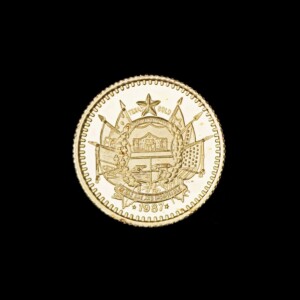
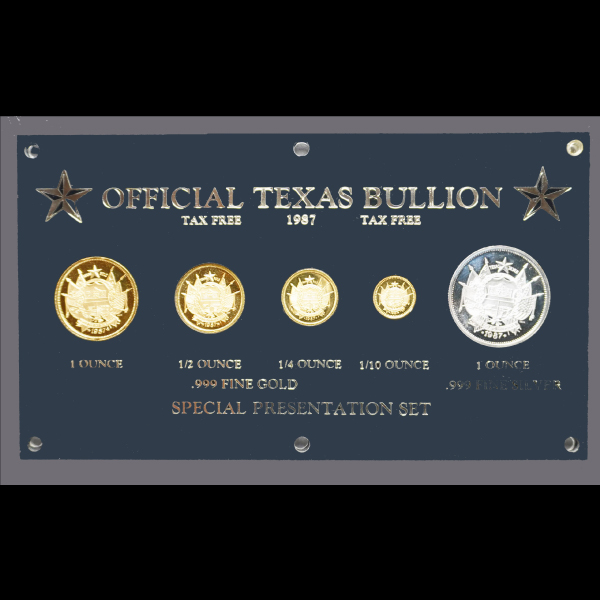
The 1987 Official Texas Bullion Special Presentation Set contains five medallions struck in .999 fine precious metals:
Gold (.999 fine):
- 1 troy ounce
- 1/2 troy ounce
- 1/4 troy ounce
- 1/10 troy ounce
Silver (.999 fine):
- 1 troy ounce
Total metal content:
- Gold: 1.85 troy ounces
- Silver: 1.00 troy ounce
The medallions are non-denominated and were issued as bullion pieces rather than legal tender coinage.
Design and Significance
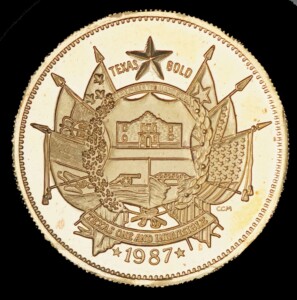
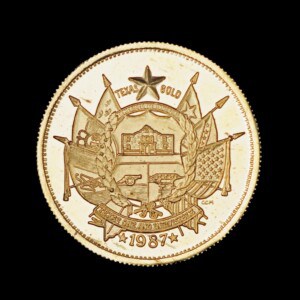
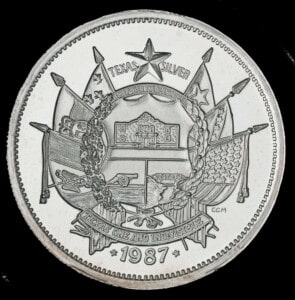
The design of the Official Texas Bullion Special Presentation Set draws directly from the heraldic structure of the Great Seal of the State of Texas. Rather than employing abstract decorative imagery, the medallions incorporate legally defined state symbolism rooted in the Texas Revolution and the Republic era.
Obverse:
The obverse imagery (derived from the reverse of the Great Seal of Texas) incorporates specific references to events that determined the outcome of the Texas Revolution.
Gonzales Cannon – Battle of Gonzales, October 2, 1835 (Gonzales, Texas)
The Gonzales cannon represents the first armed conflict of the Texas Revolution. Mexican authorities attempted to retrieve a small cannon previously loaned to settlers for defense. Texian resistance under the banner “Come and Take It” marked the opening military engagement of the revolution.
The inclusion of the cannon symbolizes the beginning of organized resistance.
The Alamo – Siege from February 23 to March 6, 1836 (San Antonio de Béxar)
The Alamo represents one of the most significant engagements of the revolution. Although Texian forces were defeated by General Antonio López de Santa Anna’s army, the battle became a rallying cry. “Remember the Alamo” became a unifying slogan during subsequent engagements.
The Alamo’s presence in the seal imagery memorializes sacrifice as foundational to independence.
Vince’s Bridge – Destroyed April 21, 1836 (near present-day La Porte, Texas)
Vince’s Bridge was destroyed under orders from General Sam Houston during the Battle of San Jacinto. By burning the bridge, Houston prevented Santa Anna’s army from retreating. This tactical decision directly contributed to the capture of Santa Anna following the decisive Texian victory at San Jacinto.
The destruction of Vince’s Bridge is widely recognized as one of the most strategically consequential actions of the revolution. Its inclusion in the seal symbolism represents calculated military leadership rather than spontaneous resistance.
Battle of San Jacinto — April 21, 1836 (Harris County, Texas)
The final engagement of the Texas Revolution lasted approximately eighteen minutes. Texian forces led by Sam Houston defeated Santa Anna’s army and secured independence. Santa Anna was captured the following day, April 22, 1836.
The San Jacinto victory formally ended organized military resistance and led to the Treaties of Velasco.
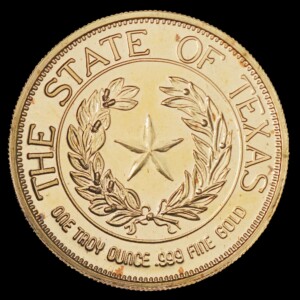
Reverse:
The Lone Star
At the center appears the five-point Lone Star, adopted by the Republic of Texas in 1836 following the Declaration of Independence signed at Washington-on-the-Brazos on March 2, 1836. The Lone Star represents sovereignty, unity, and the independent political identity of Texas as a republic prior to statehood in 1845.
Its placement at the center of the design reinforces the ideological foundation of the Texas Revolution: independent governance and territorial self-determination.
Live Oak Branch
Encircling the star is a live oak branch, a native Texas hardwood long associated with endurance and strength. In heraldic tradition, oak symbolizes fortitude and resilience. Within the context of Texas history, the live oak reflects the durability of the Republic and the persistence of frontier resistance during the 1835–1836 revolution.
Olive Branch
Opposite the live oak is an olive branch, a classical symbol of peace. The juxtaposition of olive and oak reflects a deliberate duality: Texas as a state capable of defense yet oriented toward peace following independence.
This pairing visually encodes the transition from armed struggle to sovereign stability.
Presentation Format
The defining characteristic of the Special Presentation Set is its original display configuration. The pieces were housed in an acrylic or lucite presentation tray bearing gold foil lettering identifying:
OFFICIAL TEXAS BULLION
FIRST ISSUE – 1987 – TAX FREE
SPECIAL PRESENTATION SET
The packaging is integral to the identity of the set. Complete examples retaining original presentation materials are significantly more desirable for research and collector documentation purposes than loose individual pieces.
Because the program was marketed as bullion rather than exclusively as a commemorative collectible, many sets were likely separated over time. Fully intact presentation sets therefore represent a smaller surviving population relative to total bullion output.
Program Significance
As the inaugural structured release of the Official Texas Bullion Program, the 1986 Special Presentation Set occupies an important position within Texas private-mint history. It documents a coordinated bullion branding effort that predated later state-associated bullion initiatives and reflects the intersection of regional identity marketing and precious-metal investment products in the 1980s.
The set demonstrates an early example of Texas-centered bullion positioning: combining investment-grade metal content with cohesive historical symbolism under a unified program name.
Within the broader landscape of Texas numismatic and bullion issues, the 1987 Official Texas Bullion Special Presentation Set stands as the foundational release of the series and a primary reference point for subsequent Official Texas Bullion issues.