

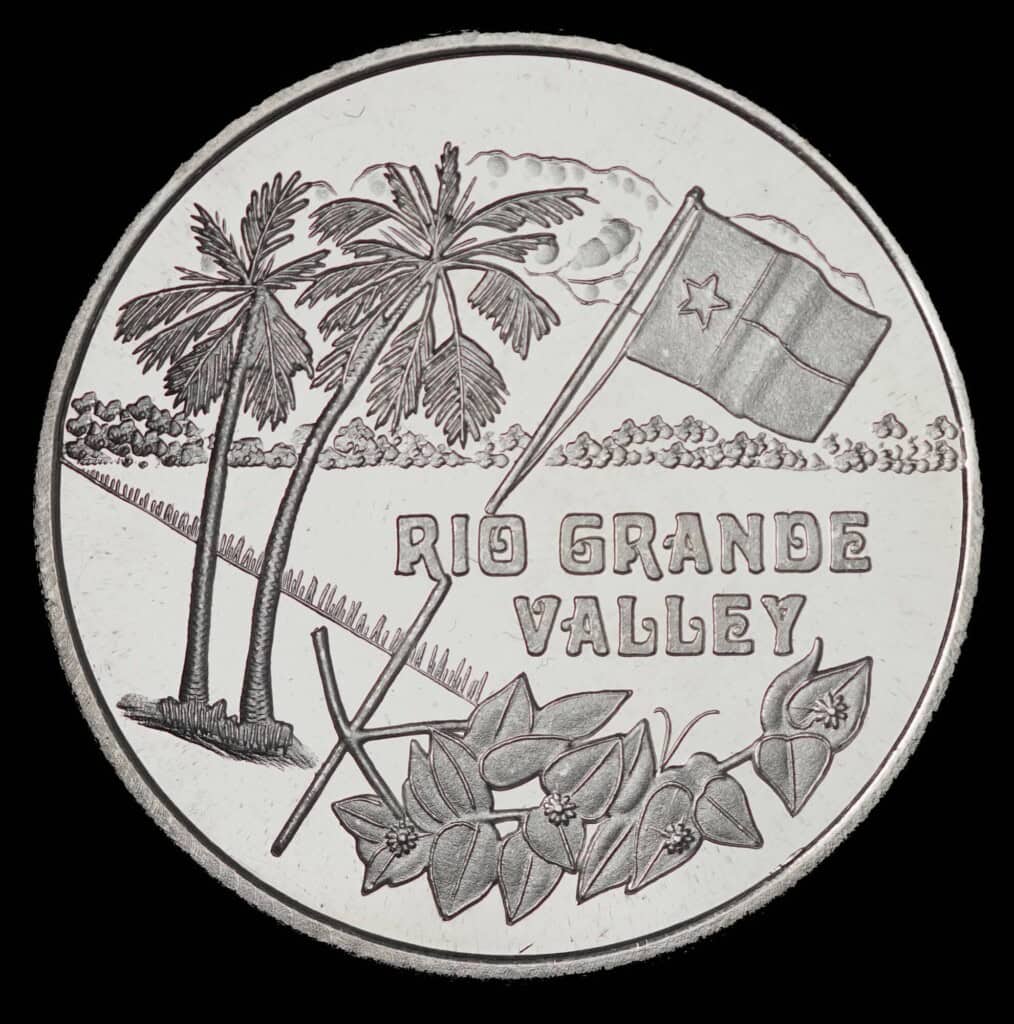
The obverse depicts a stylized Rio Grande Valley scene featuring palm trees in the foreground, a flag bearing a single star mounted on a pole, and agricultural elements including citrus blossoms and foliage. The inscription “RIO GRANDE VALLEY” appears prominently across the center. The imagery emphasizes the region’s subtropical climate, citrus production, and coastal–borderland identity along the southern tip of Texas.
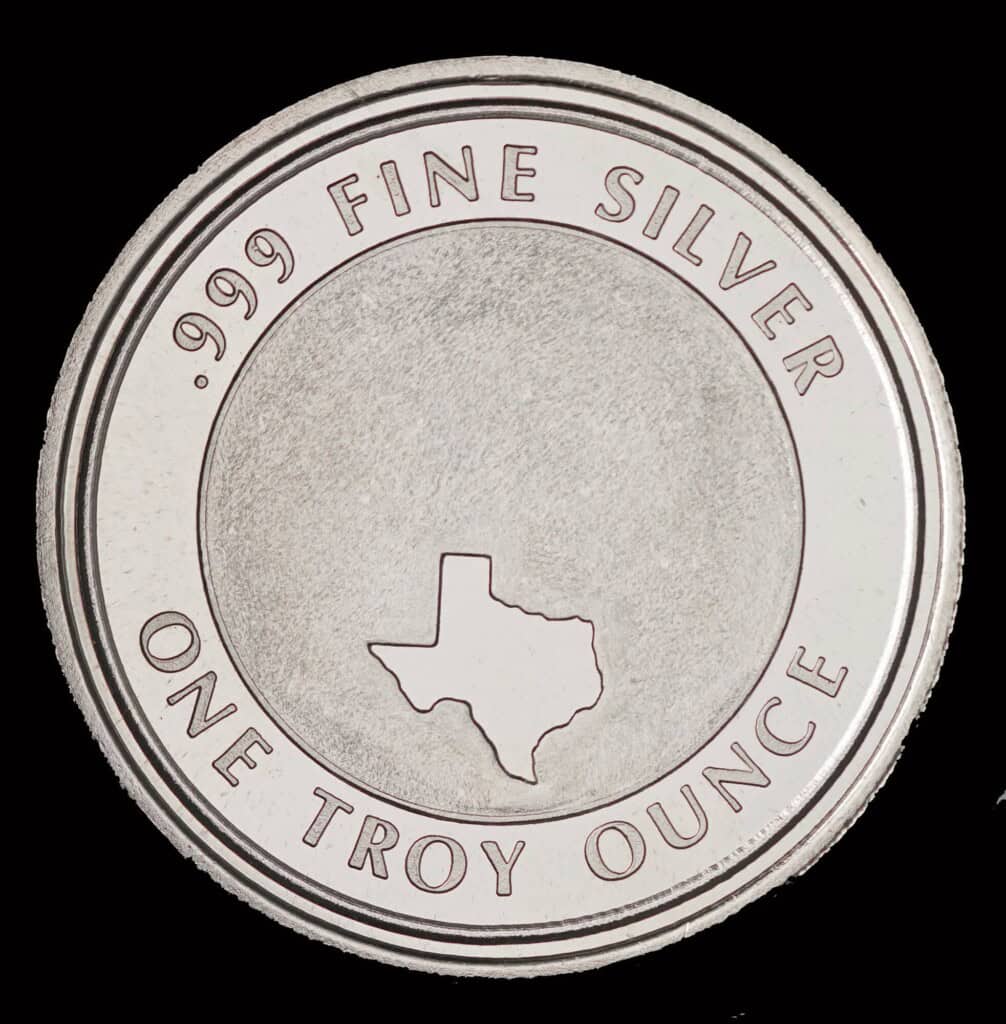
The reverse carries a circular legend reading “.999 FINE SILVER” and “ONE TROY OUNCE.” Within a recessed central field appears the silhouette outline of the State of Texas. The outer ring is raised and defined, with the central field displaying light texturing.
1985 Rio Grande Valley Silver Round Overview
The 1985 Rio Grande Valley Silver Round, attributed to World Wide Mint (Bloomington, MN), is a 1 oz .999 fine silver round depicting a stylized Rio Grande Valley scene. The obverse shows palm trees, a single-star flag on a pole, and citrus blossoms and foliage, beneath the inscription “RIO GRANDE VALLEY.” The reverse carries a Texas-silhouette device within a “.999 FINE SILVER · ONE TROY OUNCE” legend, matching the house reverse used across World Wide Mint’s Texas-themed issues of this era.
1985 Rio Grande Valley Silver Round Attribution
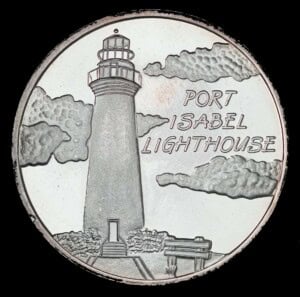
Mint is attributed to World Wide Mint on the basis of the shared Texas-outline reverse used across this mint’s confirmed and attributed Texas-era output; see the mint page for the underlying die-linkage reasoning. Distributor is attributed to John Grayson (San Benito / Harlingen, TX) — not confirmed by a direct period advertisement for this specific piece, but a reasonable working attribution given this is Grayson’s own home region and the design shares its reverse with a companion Port Isabel Lighthouse round also attributed to him. Working theory, not documentary fact: this piece may represent a custom regional order Grayson placed with World Wide Mint for his own South Texas customer base, separate from the statewide Texas 150th Anniversary Collection he also distributed.
1985 Rio Grande Valley Silver Round Historical Significance
Unlike the Texas 150th Anniversary designs, this round carries no connection to the 1836 Revolution — the Rio Grande Valley was Mexican territory at the time of Texas independence and was not incorporated into Texas until after the Mexican–American War in the late 1840s. The imagery instead reflects regional identity rooted in a much later development: the Valley’s emergence as a major citrus-growing region in the early 20th century. Large-scale irrigation from the Rio Grande, developed beginning around 1904, transformed the area’s semi-arid brushland into farmland suited to citrus and winter vegetables, and by the 1920s and 1930s the Valley had become nationally known for its grapefruit and orange production — the citrus blossoms and palm trees on the obverse point to that agricultural identity rather than to any Revolutionary-era history.
The design reads as a piece of regional pride rather than statewide commemoration: a design celebrating what makes the Valley distinct from the rest of Texas — its subtropical climate, its citrus economy, its position on the border — issued by a Valley-based dealer for his own local market, alongside (but separate from) the Revolution-themed rounds he distributed statewide.
1985 Rio Grande Valley Silver Round Notes
- Distributor attribution to Grayson is a working theory based on his regional base and shared-reverse pattern, not a documented advertisement for this specific piece — see Attribution above
- This design is thematically and historically distinct from the Texas 150th Anniversary Collection’s Revolution-era designs; it should not be treated as part of that 8-coin set
1985 Rio Grande Valley Silver Round References
- World Wide Mint (Bloomington, MN), The Texas Stacker
- John Grayson (San Benito / Harlingen, TX), The Texas Stacker
- Texas Stacker Archives