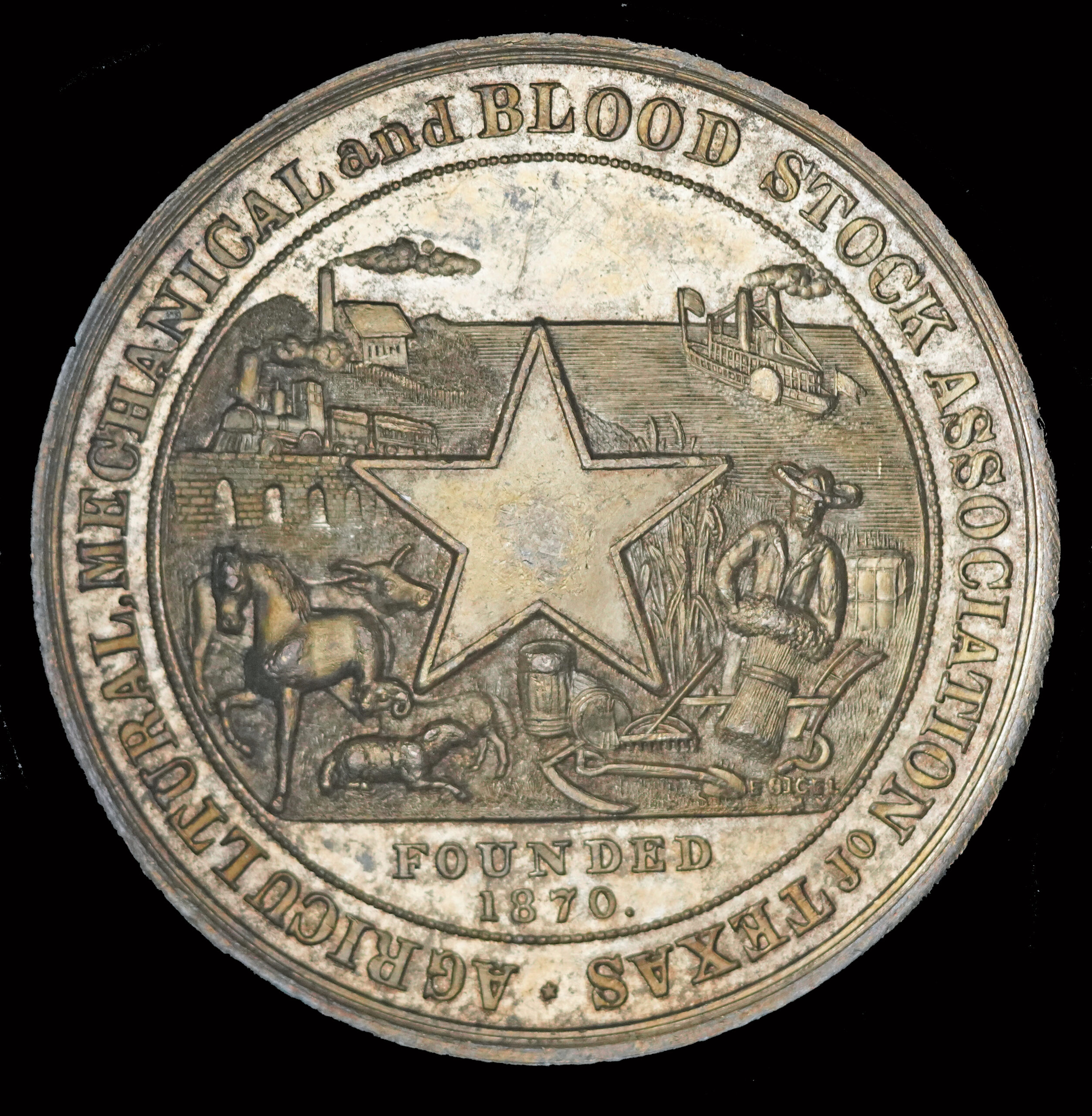

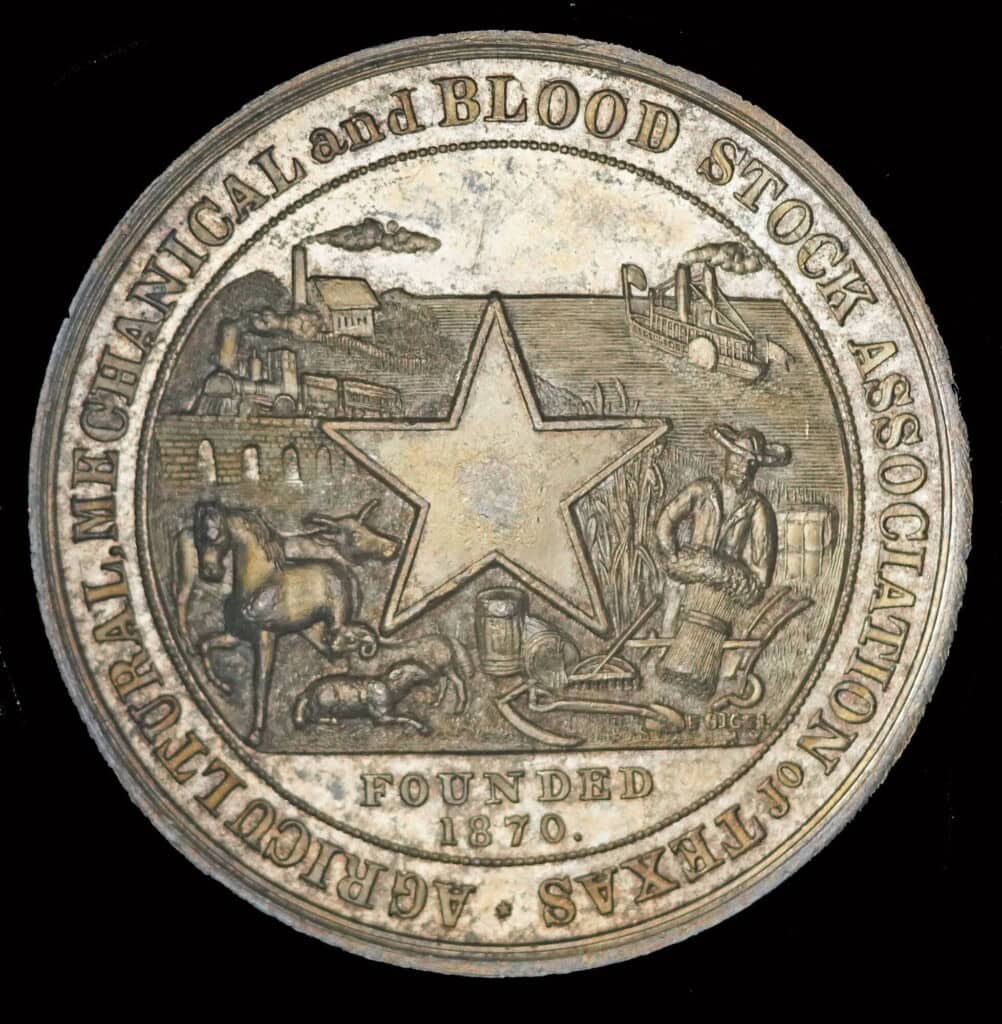
Central five-pointed star surrounded by a detailed allegorical scene representing Texas industry and agriculture: Steam locomotive crossing a bridge (rail transport and expansion), River steamboat (commerce and Gulf trade), Industrial building with smokestack (manufacturing), Farmer harvesting grain with tools and wheelbarrow, Livestock including horse, sheep, and cattle (blood stock improvement). Legend: “AGRICULTURAL, MECHANICAL and BLOOD STOCK ASSOCIATION OF TEXAS” Exergue: “FOUNDED 1870” Signature: “E. SIGEL N.Y.” (lower right)
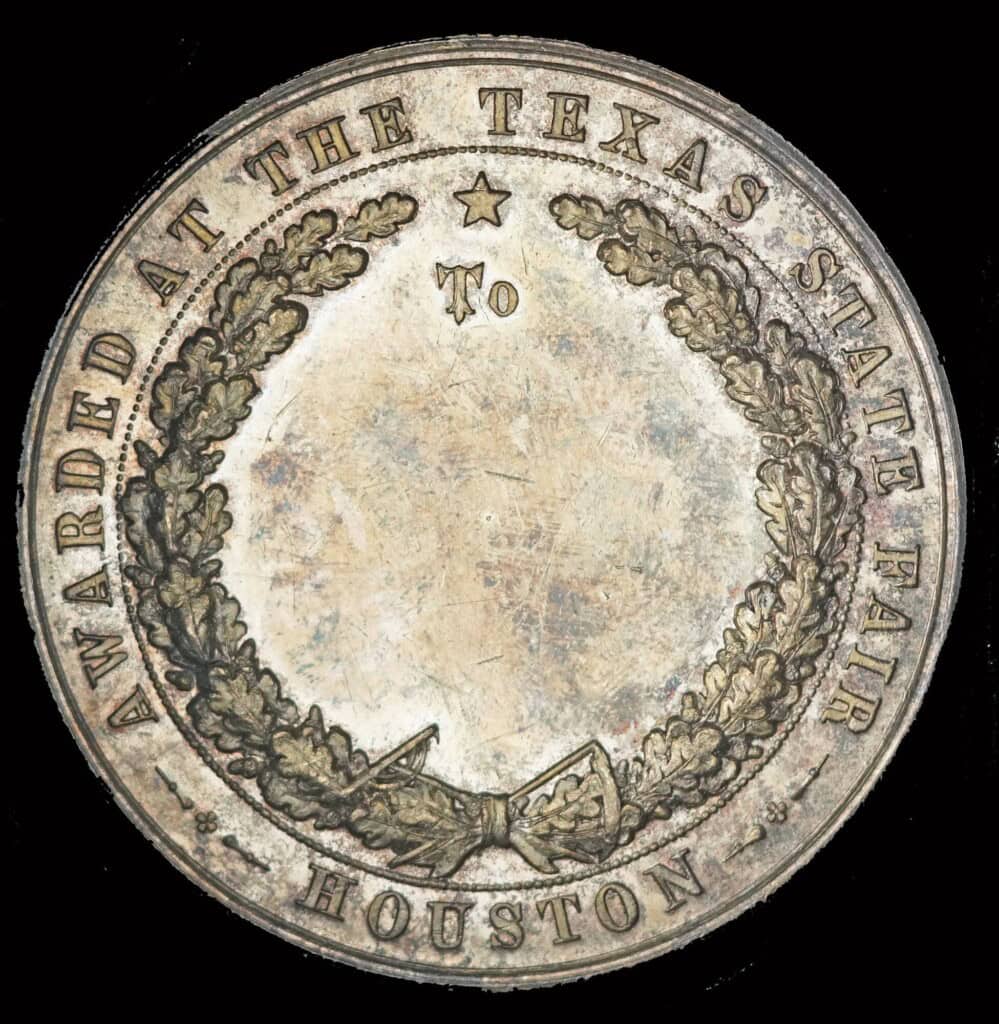
Oak wreath tied with ribbon at base, enclosing a blank central field intended for engraving. Legend: “AWARDED AT THE TEXAS STATE FAIR – HOUSTON” Interior inscription (as struck): “★ TO”
Agricultural, Mechanical & Blood Stock Association of Texas (Houston)
Overview
The 1870 Texas State Fair Award Medal was issued by the Agricultural, Mechanical and Blood Stock Association of Texas, the organizing body responsible for early statewide exhibitions held in Houston following Reconstruction. Founded in 1870, the association promoted agricultural advancement, livestock improvement, and industrial development in Texas during a critical period of economic rebuilding.
This medal represents one of the earliest known Texas fair award issues and predates the later dominance of the State Fair of Texas in Dallas. Struck in silver and engraved by New York die-sinker Emil Sigel, the medal reflects both regional ambition and national-level craftsmanship.
Unawarded specimens—such as the present example—were struck with a blank reverse field intended for recipient engraving but left unused, making them especially desirable to collectors.
Historical Significance
This medal represents one of the earliest organized efforts to formalize agricultural and industrial exhibitions in Texas. The Agricultural, Mechanical and Blood Stock Association of Texas was instrumental in promoting improved livestock breeding, mechanized farming, and regional trade.
The inclusion of railroads, steamboats, and industrial imagery reflects Texas’ transition from frontier economy to integrated participant in national commerce.
The medal’s engraving by Emil Sigel, a New York-based die-sinker known for Civil War-era tokens and commemorative medals, demonstrates that Texas organizers commissioned work from established Eastern engravers to achieve a high standard of production.
These medals predate and foreshadow the later institutionalization of large-scale state fairs, particularly the State Fair of Texas in Dallas.
Rarity & Survivorship
Award medals of this type were struck in limited quantities and distributed individually to competition winners. Many were subsequently engraved, lost, or melted during later silver price booms.
Unawarded silver specimens are scarce.
Based on known:
- Auction appearances
- Museum-held examples
- Private collections
Estimated surviving population is likely fewer than several dozen examples.
Texas State Fair (Houston) Context
The Texas State Fair held in Houston during the 1870s was among the earliest organized efforts to promote statewide agricultural, industrial, and livestock development in the post-Civil War era. Established by the Agricultural, Mechanical and Blood Stock Association of Texas in 1870, the fair served as a platform to improve breeding standards, introduce modern farming equipment, and encourage economic growth across the state. These exhibitions reflected Texas’ transition from a frontier economy to a more structured and commercially connected society. Although later overshadowed by the State Fair of Texas in Dallas, the Houston fairs represent a foundational chapter in Texas history, and medals awarded at these events are among the earliest tangible artifacts documenting that transformation.
Engraver: Emil Sigel (New York)
Emil Sigel was a mid-19th century New York–based engraver and die-sinker known for producing medals, tokens, and ornamental dies for private commissions, exhibitions, and organizations across the United States. Active during the Civil War and Reconstruction era, Sigel is documented as the engraver of several patriotic tokens and commemorative medals, including early issues for the American Numismatic Society. Operating from New York City—then the center of American medallic engraving—Sigel’s work reflects the high-relief, finely detailed style characteristic of professional die-sinkers of the period. His signature, “E. SIGEL N.Y.,” appearing on this medal confirms that the dies were produced by an established Eastern engraver, underscoring both the importance of the Texas State Fair and the desire of its organizers to commission work of national quality.