National Commemorative Society Overview
The National Commemorative Society was a members-only collectors’ club founded in Philadelphia in 1964 by Joseph M. Segel. It issued one numbered sterling silver proof medal a month honoring a person or event in American history, sold only to its members, with the subjects chosen by the members themselves. It did not strike its own medals. To make them, Segel built a mint, and that mint became The Franklin Mint. The Society is the reason The Franklin Mint exists.
Segel got the idea in the spring of 1964 from two things in the news at once. General Douglas MacArthur had died, and his funeral filled the papers; and on March 25, 1964, the U.S. Treasury stopped paying out silver dollars, after crowds had lined up to buy the last of them. Segel, a Philadelphia advertising-specialty businessman, saw collectors hungry for silver and a public ready to honor American heroes. He put about $10,000 into a society that would issue a series of solid sterling medals, each by a different sculptor, beginning with MacArthur.
He announced it with simultaneous ads in several coin magazines and kept membership open for only eight weeks. To push sign-ups, he used a sliding fee: early members paid $10 in the first two weeks, and the last to join paid $40. Segel hoped for 1,000 members, perhaps 2,000. The list closed at 5,249.
Coin-Medals
The Society’s pieces were 39 mm, struck in .925 sterling with a proof finish and low relief, so they looked like coins. In 1964 most collectors wanted coins and passed over medals, so Segel called them “coin-medals,” a name meant to bridge the gap. Every piece was numbered on the edge, the dies were destroyed when the run was finished so no more could be made, and each issue came in a presentation case with a plate naming the subject, its number in the series, and the sculptor. A monthly NCS Newsletter carried the history behind each subject, profiles of the sculptors, the members’ letters, and an official ballot. Members nominated subjects and voted on them each month; the winner became an issue a few months later, and the runners-up were carried over to the next ballot.
From the Society to The Franklin Mint
The first six NCS medals were struck by outside firms. The members were satisfied, but Segel was not. He had promised proof quality and the results fell short, and two companies he tried could not meet his standard. In late 1964 he formed General Numismatics Corporation to strike the medals himself, with Gilroy Roberts, the retiring Chief Engraver of the United States Mint and designer of the Kennedy half dollar, as chairman. Roberts solved the proof problem, and from the seventh issue on the Society’s medals came from Segel’s own plant. General Numismatics was renamed The Franklin Mint in 1965. The six outside-struck medals were later left out of Franklin Mint catalogues.
The Society kept going long after its founder’s mint outgrew it. By the 1970s it was run by the Board of Trustees of The National Historical Foundation. Series I and Series II each ran to fifty issues, the 100th, the American Clipper Ships coin-medal, coming in November 1972. That spring the members had voted overwhelmingly for a third fifty-issue series, to begin that December. The Society was still active in 1974, when it donated its Apollo 17 medal to the Smithsonian’s National Air and Space Museum.
Location: Philadelphia, Pennsylvania (1617 John F. Kennedy Boulevard in 1965)
Years Active: 1964 – 1970s (documented through 1974)
Founder: Joseph M. Segel (1931–2019), later founder of The Franklin Mint and QVC
Struck by: Outside firms for issues 1–6; The Franklin Mint from issue 7
National Commemorative Society Texas Issues
| Issue | No. | Year | Sculptor |
|---|---|---|---|
| Battle of the Alamo | 22 | 1966 | Laci de Gerenday |
National Commemorative Society Notes
- Membership closed at 5,249 (some company histories round it to 5,250). Each member received one numbered medal per issue, so Series I editions run to roughly that size; no issue-by-issue mintage has been located.
- Medals carry “NCS” and the year on the design but no mint mark. They are catalogued as Franklin Mint issues with the prefix “NCS” in Chester Lee Krause’s Guidebook of Franklin Mint Issues.
- Segel ran other membership medal societies on the same model, including the Britannia Commemorative Society (1965). These were separate series and are not NCS issues.
National Commemorative Society References
- A Short History of the Franklin Mint, David T. Alexander, The E-Sylum, Numismatic Bibliomania Society
- The Rise and Fall of the Franklin Mint, David T. Alexander, CoinWeek
- The Franklin Mint History, International Directory of Company Histories
- Joseph M. Segel (1931–2019), The E-Sylum, Numismatic Bibliomania Society
- The National Commemorative Society Newsletter, 1966 and April 1972 and November 1972 issues (Newman Numismatic Portal)
- Coin World, December 29, 1965, p. 66 (National Commemorative Society address, Philadelphia)
- Medal, Commemorative, Apollo 17, National Commemorative Society, Smithsonian National Air and Space Museum
- Chester Lee Krause, Guidebook of Franklin Mint Issues, 9th ed. (Krause Publications, 1982), National Commemorative Society
- The Franklin Mint (Franklin Center, PA), The Texas Stacker
- 1966 Battle of the Alamo – National Commemorative Society Silver Medal, The Texas Stacker
- Texas Stacker Archives
Coins from National Commemorative Society (Philadelphia, PA) (1)
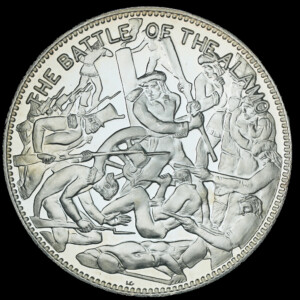
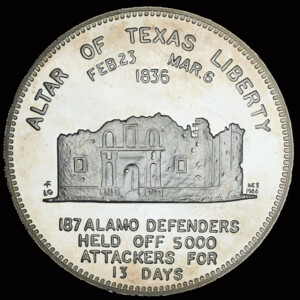
1966