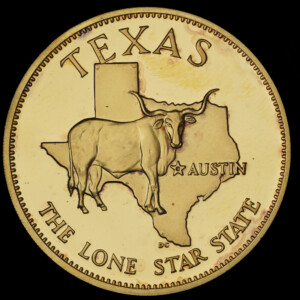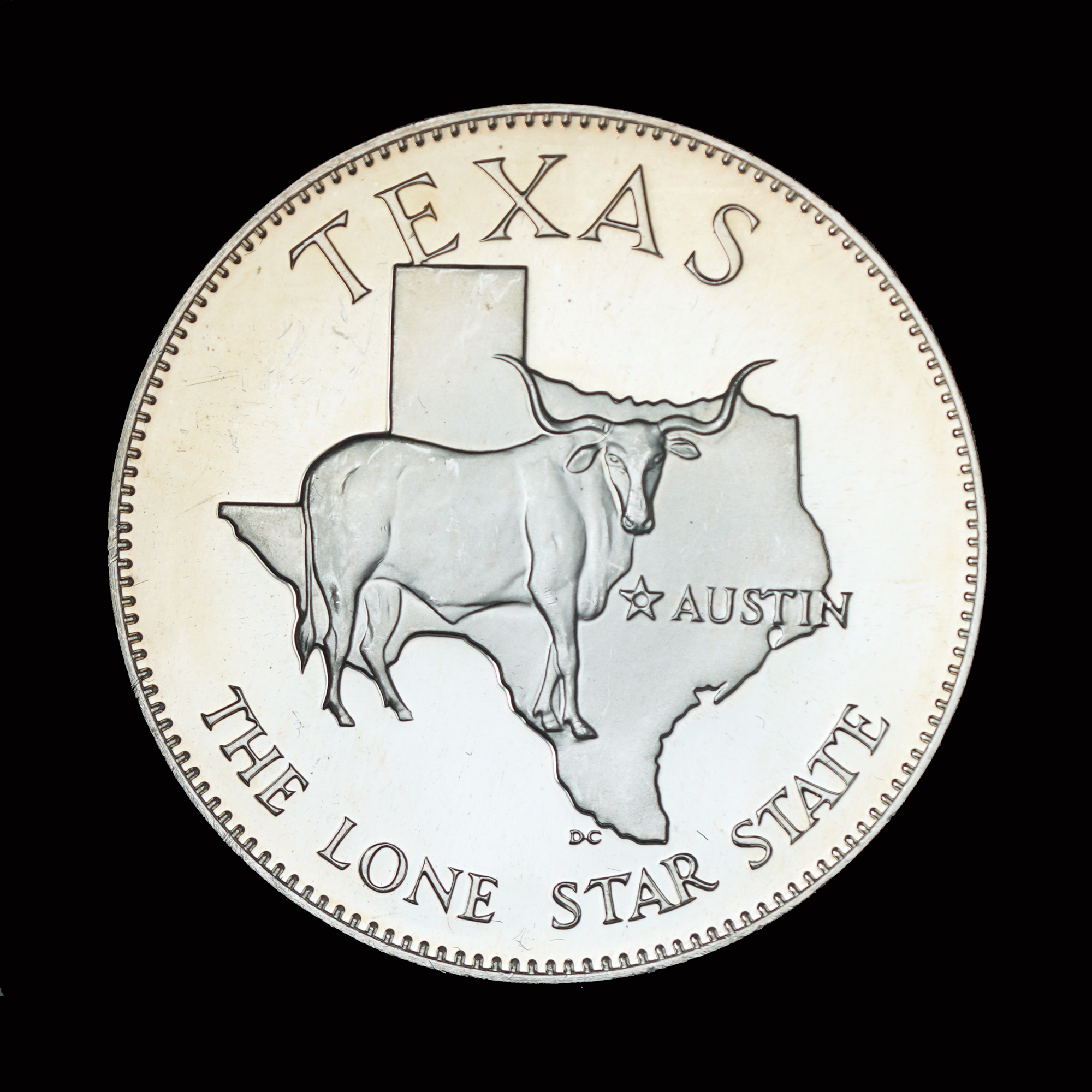
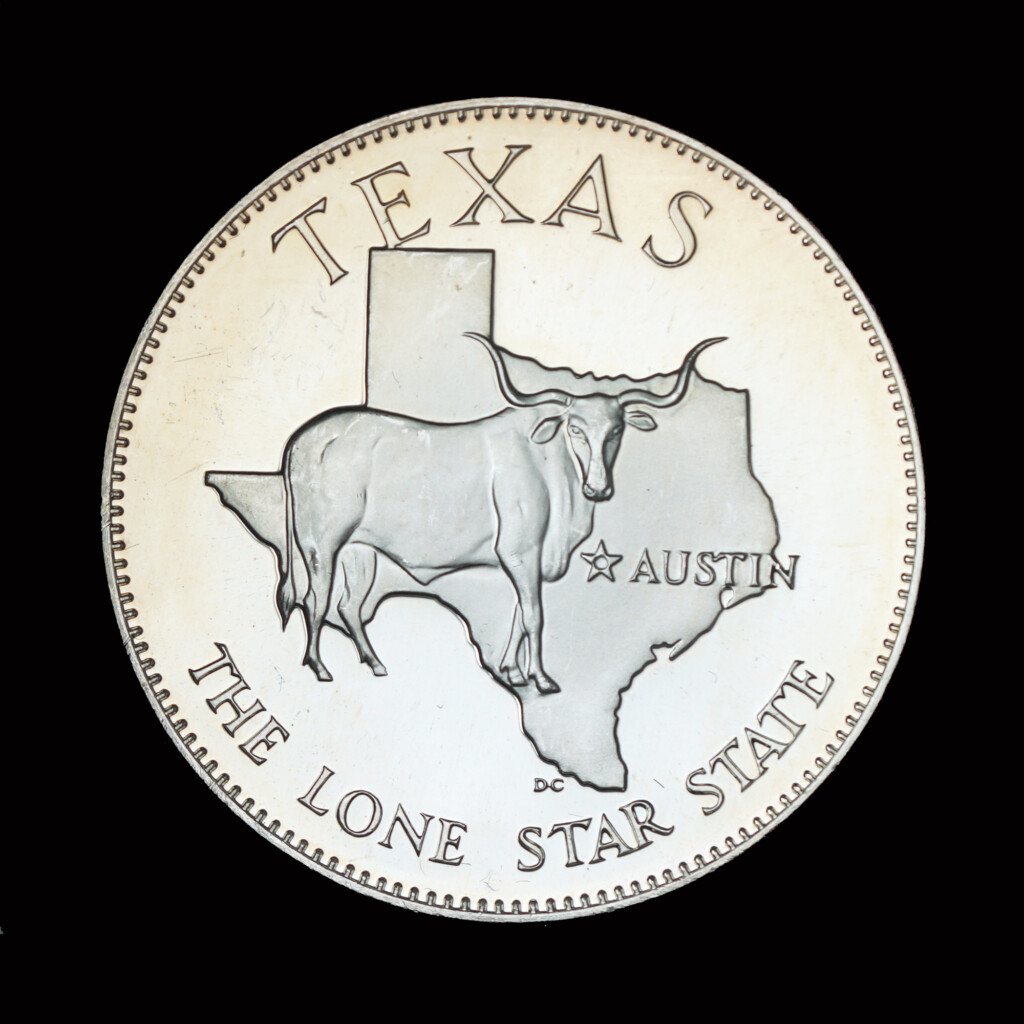
A Texas Longhorn steer stands in high relief across a raised map of Texas, with a star and “AUSTIN” marking the capital and the designer’s initials “DC.” “TEXAS” arcs above and “THE LONE STAR STATE” runs along the lower rim, within a beaded border.
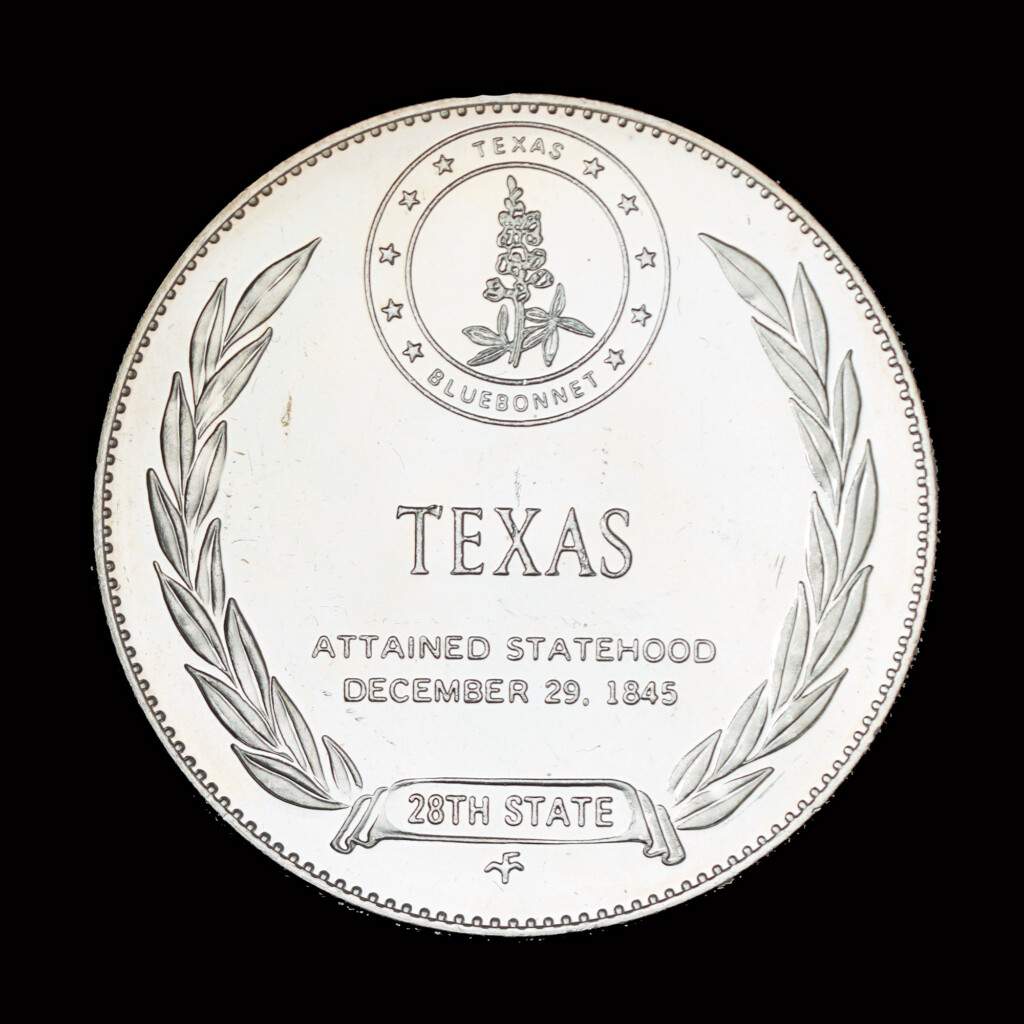
The state flower with the legends “TEXAS” and “BLUEBONNET,” above the statehood inscription “TEXAS ATTAINED STATEHOOD DECEMBER 29, 1845 · 28TH STATE” and the Franklin Mint “FM” mark.
Struck and issued by The Franklin Mint, identified by the struck “FM” mark, as the Texas medal of the 1969–1970 States of the Union Standard Edition in sterling (32 mm). Proof and prooflike finishes. Obverse signed “DC” (David Cornell).
The 1969 Franklin Mint States of the Union Texas sterling silver medal has a modest but steady sales history from 2018 through 2026, with a recent sale in June 2026.
| Date | Price | Notes |
|---|---|---|
| Jun 8, 2026 | 65.00 | Most RecentHighest Ever |
| Nov 27, 2025 | 24.50 | |
| Jun 12, 2025 | 29.99 | UnverifiedTitle states 1/2 oz .925; same Franklin Mint design, kept per unmarked |
| Dec 3, 2024 | 65.00 | Highest Ever |
| Mar 8, 2024 | 19.00 | |
| May 30, 2023 | 29.99 | |
| Jun 9, 2020 | 16.95 | |
| Nov 27, 2019 | 14.95 | |
| Apr 4, 2019 | 14.95 | |
| Dec 31, 2018 | 16.14 |
Scroll for full 10-sale history ↓
1969 Texas – States of the Union Silver Medal Overview
The 1969 Texas – States of the Union Silver Medal is the Texas medal from the Standard Edition of The Franklin Mint’s States of the Union series, fifty sterling medals honoring each state in the order it entered the Union. Collectors subscribed and received the medals one at a time until the set was complete, then mounted them in a two-page album that showed both sides of every medal. It was the most widely sold version of the series, struck in proof and in a much smaller prooflike run. The same design was later enlarged for the Governors’ Edition, documented here as the 1970 Texas – States of the Union Gold-Plated Silver Medal.
The obverse puts a Texas Longhorn over a raised map of the state, with a star at Austin and the nickname “THE LONE STAR STATE” below. The reverse carries the bluebonnet and the line that sets Texas apart from every other medal in the set: “TEXAS ATTAINED STATEHOOD DECEMBER 29, 1845 · 28TH STATE.” No other state honored on the series had been its own country first.
From Revolution to Republic
The road to that date began at Gonzales on October 2, 1835, when Texian settlers refused to give a small cannon back to Mexican troops and dared them, under a homemade flag, to “Come and Take It.” On March 2, 1836, delegates at Washington-on-the-Brazos declared Texas independent. Four days later the Alamo fell to Santa Anna after a thirteen-day siege, and on March 27 some 350 Texian prisoners were shot at Goliad. On April 21, 1836, Sam Houston’s army caught Santa Anna’s camp at San Jacinto and, crying “Remember the Alamo! Remember Goliad!”, won the battle in about eighteen minutes. Santa Anna was captured the next day.
The Republic of Texas
For nearly ten years Texas was a nation, with its own president, army, navy, and money, and a single-star flag that gave it the name the Lone Star. It was also deep in debt, unrecognized by Mexico, and raided twice by Mexican armies. Many Texans wanted to join the United States from the start, but Congress put off annexation for years over the question of adding another slave state.
The 28th State
Congress finally approved a joint resolution to annex Texas on March 1, 1845, and a Texas convention accepted it that July. On December 29, 1845, President James K. Polk signed the act admitting Texas as the 28th state, the date struck on this medal. The formal handover came on February 19, 1846, in Austin, when President Anson Jones lowered the Lone Star flag and declared, “The final act in this great drama is now performed; the Republic of Texas is no more.”
The Longhorn and the Bluebonnet
The two emblems the Franklin Mint chose for Texas were both in the Legislature’s hands as the series came out. The Longhorn, descended from Spanish mission cattle and driven north by the hundreds of thousands after the Civil War, had nearly disappeared by the 1920s before federal rangers and Texans J. Frank Dobie, Graves Peeler, and Sid Richardson gathered herds to save it. On May 14, 1969, the Texas Legislature designated the herd at Fort Griffin the Official State of Texas Longhorn Herd. The bluebonnet had been the state flower since March 7, 1901, but only one species of it was named in the law, and on March 8, 1971, the Legislature added Lupinus texensis “and any other variety of bluebonnet not heretofore recorded.”
1969 Texas – States of the Union Silver Medal Attribution
The struck “FM” identifies The Franklin Mint as maker and issuer. The obverse is signed “DC,” the initials credited to David Cornell on the series’ Nebraska medal. Neither face carries a date. The proof’s edge is stamped “69,” and the Standard Edition was issued in 1969 and 1970. The prooflike strikes have a plain edge and carry no date anywhere. They are included in this entry under the 1969 issue year.
1969 Texas – States of the Union Silver Medal Notes
- The proof and prooflike strikes are told apart by the edge: lettered on the proof, plain on the prooflike.
- Mintage figures for the Standard Edition are published per state for the series as a whole. No separate Texas figure has been located.
1969 Texas – States of the Union Silver Medal References
- Documented examples examined (this entry): proof and prooflike
- Chester Lee Krause, Guidebook of Franklin Mint Issues, 9th ed. (Krause Publications, 1982), States of the Union series
- Franklin Mint States of the Union Medals — editions, mintages, issue prices
- Numista N#400280 — States of the Union, Standard Edition sterling
- Numista N#404945 — States of the Union (Nebraska), designer David Cornell
- Texas Historical Commission — Official State of Texas Longhorn Herd
- Legislative Reference Library of Texas — Bluebonnets and the Texas Legislature
- 1970 Texas – States of the Union Gold-Plated Silver Medal, The Texas Stacker
- The Franklin Mint (Franklin Center, PA), The Texas Stacker
- Texas Stacker Archives